


 Next up in our “how-to” series, it’s the turn of the support gunner. You tend to find support gunners in larger airsoft events that have restrictions placed on the number of support guns allowed, and they can be invaluable in these scenarios.
A support gunner will often be equipped with a Light Machine Gun (LMG) – otherwise known as a Squad Automatic Weapon (SAW) – and if utilised correctly, they can help to make everyone in their squad feel a little safer.
You may think that anyone equipped with airsoft rifles and large magazines can be a support gunner, and while that’s technically true, there is something almost menacing about coming face to face with someone equipped with a light machine gun and a magazine that can hold over 1,000 BBs! Some skirmish sites have special rules about what is and isn’t a support gun; you can’t always just strap a box mag into an M4 and go nuts!
So, how do you go about becoming a support gunner?
Next up in our “how-to” series, it’s the turn of the support gunner. You tend to find support gunners in larger airsoft events that have restrictions placed on the number of support guns allowed, and they can be invaluable in these scenarios.
A support gunner will often be equipped with a Light Machine Gun (LMG) – otherwise known as a Squad Automatic Weapon (SAW) – and if utilised correctly, they can help to make everyone in their squad feel a little safer.
You may think that anyone equipped with airsoft rifles and large magazines can be a support gunner, and while that’s technically true, there is something almost menacing about coming face to face with someone equipped with a light machine gun and a magazine that can hold over 1,000 BBs! Some skirmish sites have special rules about what is and isn’t a support gun; you can’t always just strap a box mag into an M4 and go nuts!
So, how do you go about becoming a support gunner?
Primary Objectives of Support Gunner
As we said, you could probably grab an automatic airsoft gun, large capacity magazines and loads of BBs and label yourself as a support gunner. But in order to be an effective support gunner, you will need to look at equipping yourself with something like the Classic Army CA063 LMG. This kind of airsoft gun is going to help you fulfil your primary objective as a support gunner more effectively than other systems, with that objective being direct suppression. In other words, you will need to lay down heavy fire on your target so that the rest of the team can move to engage.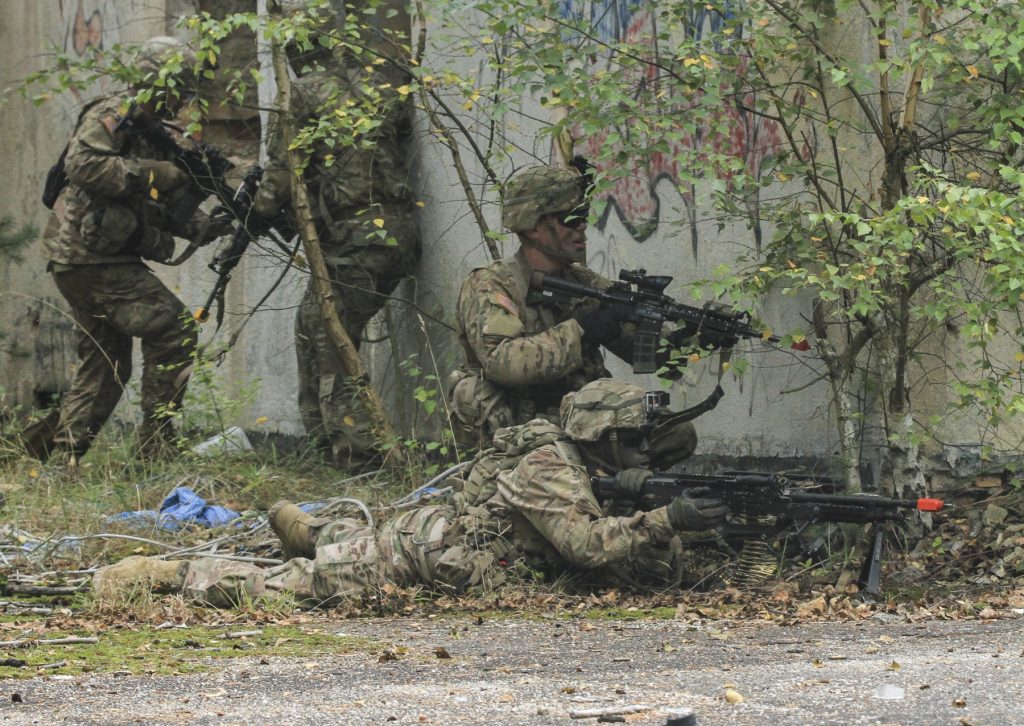
Photo credit: Sgt. Lauren Harrah/Released
You need to remember that as a support gunner, you need to do exactly what it says on the tin; support. You’re not part of the assault or manoeuvre element, but you are there to allow the rest of your team to fulfil their roles. You won’t be a run and gun, shoot from the hip player, but rather you’ll take up a position, allow your team to advance, move to a new position and repeat. You may also need to take up positions, lay down fire and allow your team to retreat.
Firing the SAW
The way you operate with your SAW is important. Many beginners will make the mistake of setting up their position, aiming at their target and keep the trigger held down. While the temptation to do this is quite overwhelming, it can give away your position very quickly, waste a lot of ammo and leave the rest of your team feeling pretty p’eed off! As a general rule of thumb, you should look to fire bursts, which helps to keep you in control, but also allows the scope for longer bursts should you need it. When it comes to firing the gun, you are likely going to be doing it in one of three positions; standing, kneeling and prone.Standing
The gunner will need to position the SAW into their shoulder, grasping the pistol grip in the firing hand and holding the handguard in the off-hand. This position is often used when moving to a more stable position and one with better cover. Aiming down the sites and firing 3 to 5 round bursts will help to keep yourself and the rest of your team protected. This can be quite a tiring firing position, as the SAW systems tend to be much heavier than other airsoft guns, particularly if it is a RIF. This is when the use of a sling may be beneficial for the user. Having the gun in a sling can make manoeuvring much easier, while also taking away some of the carry strain. Check out our range of slings available here. You may also utilise the standing position in situations where the cover comes up to around chest height. If this is the case, deploying a bipod can help to give you a much more stable firing platform, which is particularly helpful when you are advancing on an enemy position. Some systems will have a built-in bipod but others can be purchased separately and fitted for more stability.Kneeling
Kneeling is quite often the most common firing position when using the SAW system. It tends to put you in the same position of fire as you would when you are standing, but you drop to a knee to support the weight of your weapon. This tends to offer you a much more stable position than standing, due to the body-to-body contact of your arms to a knee. The kneeling position will often be seen in areas that have low-to-ground cover, such as walls, fences, lines of bushes, etc. and gives the gunner the ability to fire from a lower profile, which can be useless in a number of scenarios.Prone
By far the most stable of the firing positions is laying down and using the SAW system. However, to effectively be able to do this, you will need to have a bipod fitted. It may be possible to fire without, but it will be a heck of a lot easier with.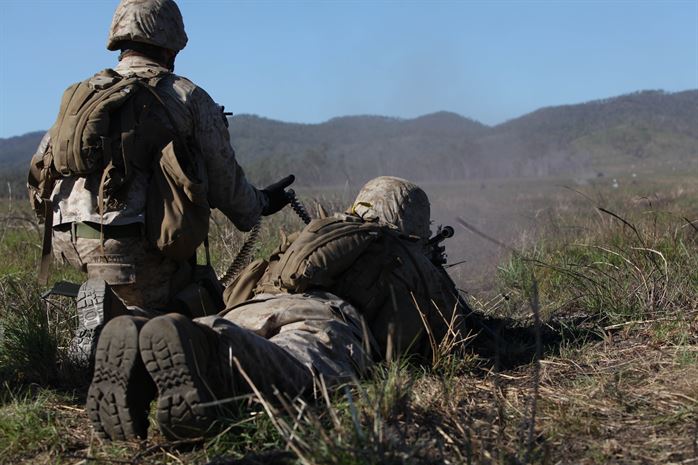
Photo credit: Lance Cpl. Brennan O'Lowney
Once the bipod has been deployed, you need to lower your body behind the weapon, placing the stock into your shoulder. Then, rest your cheek on the stock, grab the pistol grip and pull the weapon back, so it is sitting snugly into your shoulder. Your free hand should then rest on the stock slightly in front of where your cheek is but ensuring it does not block your line of sight. Once you’ve got this sorted, you need to make sure your body is as low as possible to the ground. Your body should be at around a 45-degree angle from the weapon, leaving your legs spread for stability and the leaving the insole of your feet as flat to the ground as possible. When used in conjunction with defensive positions such as fighting holes, bunkers and holes in walls, it can be an extremely strong and safe position, which can be used with devastating effect.Requirements of a Support Gunner
 As we stated in the primary objectives section above, suppressive fire is what you will mostly be doing as a support gunner. But in order to do this effectively, there are certain skills and traits that will make some people more adept at the role than others, which we’ve looked at below:
1 Comment